
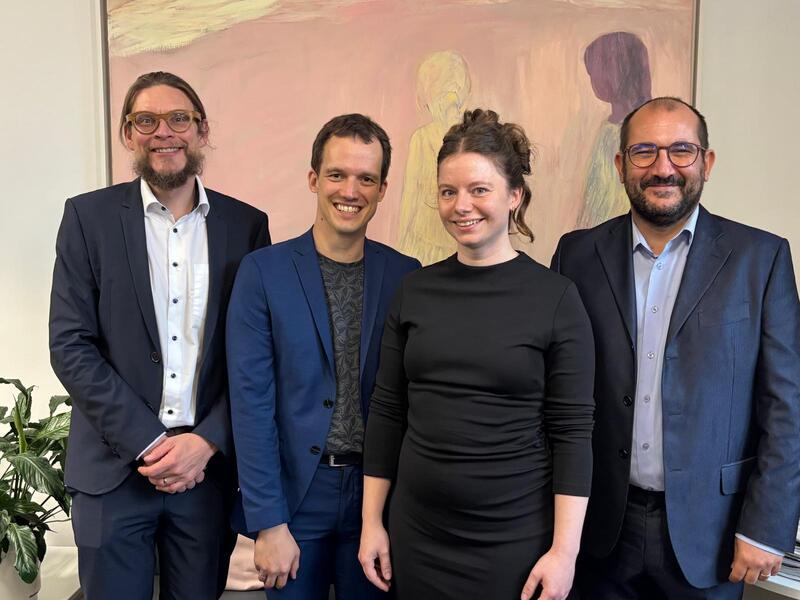
With great pride and happiness, I let you know that soon to be Dr. Ricarda Duerst successfully defended her PhD thesis “Learning from past mistakes : Uncertainty in demographic forecasting”.
Ricarda wrote her thesis based on the idea that a prediction is only as good as similar predictions in the past turned out to be. Based on this she performed forecasts with associated uncertainties which humbly reflect our actual, demonstrated ability to predict an event.
The tools that Ricarda developed and demonstrated in her thesis give forecasters the means to learn from past mistakes and to reflect them in future forecasts. Her supervisors, Mikko Myrskylä and Jonas Schöley, congratulate Ricarda on her achievement and expect further developments along the path laid out in this work.
Special thanks go to Giancarlo Camarda, the honored opponent during Ricarda’s defense, who discussed her thesis in great depth.
Ricarda found ways to connect the methodological advances in her thesis with substantial research questions. As Ricarda embarked on her PhD journey around COVID-19 this topic is naturally reflected in her work. By framing excess deaths as a forecasting problem and analyzing the seasonality of the forecast error, Ricarda showed that 10% excess in winter is not the same as in summer. The first is sadly business as usual in many countries, the latter quite unusual. This analysis has informed media reporting during the pandemic. This work has been published in “Empirical prediction intervals applied to short term mortality forecasts and excess deaths”.
In “The contribution of forecast uncertainty to lifespan uncertainty” Ricarda has shown that uncertainty around future mortality rates contributes little to an individual’s uncertainty about their length of life. This is even true when accounting for the possibility of future wars or pandemics. This work gives further credibility to the interpretation of life table lifespan variability as individual uncertainty.
Working with Statistics Finland Ricarda applied the logic of empirical prediction intervals to the prediction of future fertility trends. She developed a method to calibrate simulated possible TFR trajectories to the actual distribution of forecast error observed from past attempts of forecasting fertility. A central finding of this empirical work on forecast error is that we underestimate it in the short term, and, counter-intuitively, may overestimate it in the long term. See the thesis for a current draft.
Ricarda continues in science and is working at the University of Rostock alongside Roland Rau.